Patagonian Seahorse
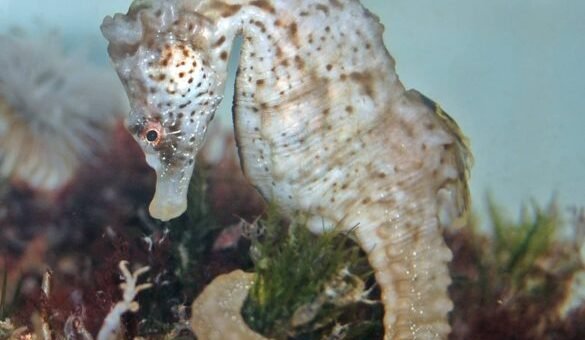
What it is
Described for science only in 2004, by Piacentino and Luzzatto, from specimens collected at San Antonio Oeste (Río Negro). Before that date it was confused with Hippocampus erectus. It measures between 6 and 15 cm. It has low spines, a short snout and a long prehensile tail; the crown on its head is a low ridge. Colour ranges from light to dark brown, and also yellow, red or orange, with irregular dark striations and small white spots.
Despite its name, its range is broad: it is recorded from north-eastern Brazil to Chubut, Argentina. In Argentine waters it is usually found at shallow depths (down to about 15 m); in Brazil it has been found as deep as 120 m. It lives attached by its tail to natural and artificial substrates — seagrass beds, macroalgae, sheltered areas with sessile invertebrates. Juveniles attach themselves to floating substrates and drift with currents, which explains such a wide range for such a sedentary animal.
It's the father who gets pregnant. The male incubates the eggs in a ventral pouch and gives birth to fully formed live young.
Conservation status
IUCN Red List, 2017 assessment, criterion A2cd, e.T195100A54909767. The assessment infers a population decline of at least 30%, based on habitat quality deterioration, reduced extent of occurrence, and declines reported by fishers. All species in the genus Hippocampus have been listed in CITES Appendix II since 2004. In Argentina, coastal monitoring in Patagonia recorded a population decline of close to 80% between 2005 and 2019. The municipality of San Antonio Oeste declared it a Natural Monument.
Threats
Habitat degradation and loss from coastal development; destructive fishing practices; targeted extraction; incidental capture in shrimp trawling; tourism pressure on its settlement areas; and trade in dried specimens as souvenirs.
Its two known Argentine population centres are in Mar del Plata and San Antonio Oeste — that is, in beach towns, under breakwaters and piers that people walk past every day of the summer. And it attaches itself to whatever it finds, including an abandoned fishing line. A Patagonian seahorse clinging to a lost fishing line is the complete picture of the problem.
Related activities
- The shadow of the wave
- Pregnant dad
- Eyes on the shoreline
- Substrate
- Wei, J., Estalles, M.L., Pollom, R. & Luzzatto, D.C. (2017). Hippocampus patagonicus. The IUCN Red List of Threatened Species 2017: e.T195100A54909767.
- Piacentino, G.L.M. & Luzzatto, D.C. (2004). Hippocampus patagonicus sp. nov., a new seahorse for Argentina (Pisces, Syngnathiformes). Revista del Museo Argentino de Ciencias Naturales, n.s. 6(2): 339-349.
- CITES, Appendix II (in force since 2004 for the genus Hippocampus).
- Mongabay Latam (2025) report on monitoring and conservation of the species.